Healthy Soil Starts Now: A Fall Guide to Understanding and Improving Your Soil
Have you ever considered what lies beneath your feet when you're out in the field?
Before diving into fall soil sampling, gypsum amending decisions, sodium management, or CEC balancing, let’s take a moment to step back and start with the basics.
Your soil isn’t just dirt; it’s not merely minerals or biology. Soil is a living community—an entire neighborhood beneath your feet. It breathes, digests, circulates water and nutrients, and responds to the way you treat it. As Jerry Brunetti wrote in The Farm as Ecosystem, soil functions like a “supraorganism”— …a whole living system made up of interconnected physical, chemical, and biological parts working together. When one part weakens, the rest compensate…for a while.” Soil is an interdependent system with “checks and balances,” much like the game Rochambeau (Rock, Paper, Scissors). However, when the system is stressed for too long, signs appear in the field: weak vigor, uneven fruit set, sodium issues, poor crop quality, nitrogen loss, disease pressure, or declining organic matter.
Many growers don’t notice these problems because they build so slowly.
Understanding this foundational concept is key to improving your soil this fall, and it sets the stage for our exploration of essential soil health strategies that can enhance productivity and sustainability in your farming practices.
How Soil Really Works — The Three Systems That Drive Everything
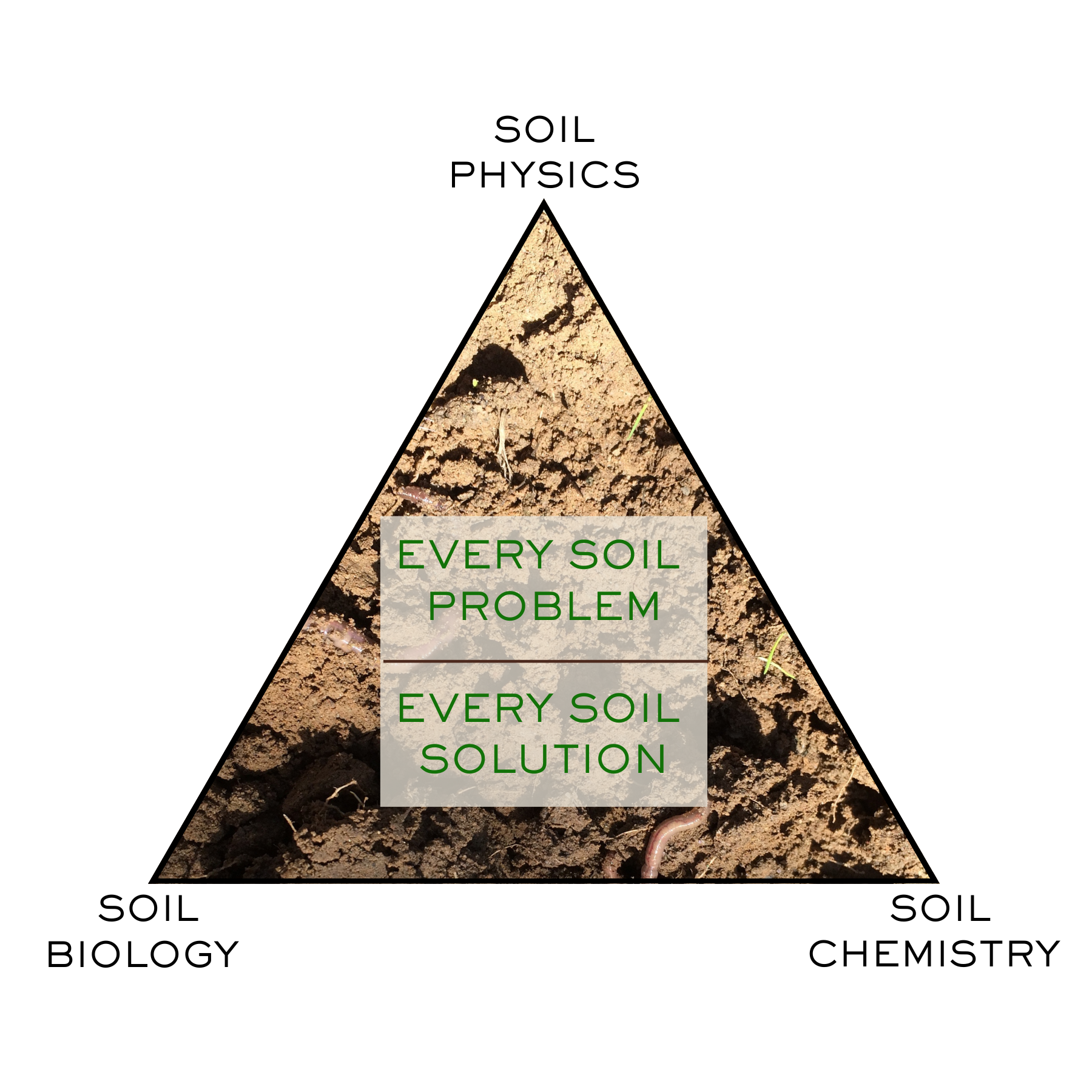
Healthy, productive soil isn’t one thing — in simple terms, it’s three systems working together. When you understand how these systems interact, everything from soil testing to nutrient management decisions becomes more straightforward.
1. Soil Physics — the Structure
This is the physical side of the soil:
Structure and aggregation
Texture (sand, silt, clay)
Pore space
Compaction
Water infiltration and drainage
Physics determines how air and water move. If pore space is tight, nothing else can function well — roots can’t grow, microbes can’t breathe, and nutrients can’t move into solution.
2. Soil Chemistry — the Nutrient Inventory
Chemistry includes: Anything added to the soil
Nutrients: Which include positively charged cations like Ca2+, Mg2+, K+, Na+, etc. and negatively charged anions like NO3-, PO43-, SO4-, etc.
Amendments: gypsum, limestone, compost, manure, etc.
The “-icides”: Herbicides, insecticides, nematicides, fungicides, etc.
Water
Chemistry is what’s in the soil’s “pantry” — how many nutrients are present and how they’re balanced. But chemistry alone doesn’t feed a crop. It only tells you what the soil is holding, not what’s actually available.
3. Soil Biology — the Workforce
Biology includes:
Bacteria
Fungi
Yeast
Nematodes (bad and good)
Earthworms
Biology is what unlocks the chemistry. Microbes process nutrients into plant-ready forms, improve soil structure, release bound minerals, and keep the entire soil system functioning. Without biology, nutrients stay stuck on soil particles and never enter the plant.
These Systems Are Interconnected
If physics collapses, biology suffocates.
If biology slows down, chemistry locks up.
If chemistry becomes imbalanced, structure tightens and infiltration drops.
Every soil problem — and every soil solution — sits somewhere inside this triangle.
This is why principles like nutrient balance, bio-availability, source vs. sink, and the P-N-K Principle matter so much. Plants don’t eat nutrients sitting on a soil particle. They only absorb what biology brings into solution at the right time.
Understanding these three systems forms the foundation for every fall soil decision that follows.

You Must Measure It Before You Can Manage It
No matter what crop you grow, soil health has to be a priority. Healthy soil grows healthy plants — with balanced vigor, consistent fruiting, and the ability to carry a crop without giving up quality. And when you start seeing problems above ground — weak plants, infections, inconsistent set, poor sizing and quality — it’s usually a sign to look below the surface.
To understand soil health, you have to know what’s in the soil. A mentor once told me, “You must be able to measure it in order to manage it.” He was right. Everything starts with a representative soil test.
Not all soil tests are the same, but a complete soil audit shows you the objective measurements of these four things:
Nutrient inventory — what’s physically present
Soil texture — how the soil is built
Nutrient release — what’s actually available
Microbial levels — how active the biology is - or is not.
Remember the data you get from your Ag lab is only as good as the sample gathered. This is why it’s important that the samples collected are representative of the conditions needing attention. When there are issues in areas or blocks, these may require separate sample sites to more precisely diagnose and build a data-driven corrective treatment plan.
In addition, the extraction method(s) used by the lab also play a key role in those results. Different extraction methods release different amounts of nutrients from the soil, and those differences matter when you’re trying to make accurate decisions. If you want reliable information, you need both good sampling and the right extraction method — otherwise you could be making decisions with inaccurate information.
Measuring correctly up front sets the stage for everything that follows. It’s how you turn soil science into confident nutrient management decisions.
A Lesson in Assumptions
In a recent conversation with a grower, I encountered a classic example of how assumptions can lead to costly decisions. He was applying gypsum to his apple orchard, convinced that his apples needed calcium to prevent bitterpit, a calcium deficiency that causes internal fruit breakdown. While his intentions were good, I asked him a crucial question: “Does your soil actually need calcium? Does your soil analysis show you need calcium amending?” To my surprise, he admitted that they hadn’t used a soil test; they simply applied gypsum, as it is an industry standard practice, and it was their routine. After some discussion, I convinced him to allow a soil sample to be collected from his block to better understand his soil’s needs. The soil analysis revealed that the grower's calcium level was more than adequate for his soil's cation exchange capacity (CEC), and amending wasn't needed. However, he had already made the application. What the soil analysis showed us was that he wasn't getting adequately efficient root uptake of the calcium from the soil inventory. This experience underscores the importance of informed data-driven decisions in agriculture. Good intentions alone do not guarantee good results; understanding your soil is the key to optimizing productivity and ensuring the longevity of your crops.
Sodium — The Quiet Soil Disruptor
Sodium is a slow builder. In the West, where irrigation water is often high in salts (like sodium and boron) and winter rainfall is limited, sodium tends to accumulate unless we actively manage it. You don’t notice it at first, but over time sodium begins changing the way your soil behaves.
Sodium works directly against calcium. Calcium builds soil structure by helping clay particles form stable aggregates. Sodium tears that structure apart. When sodium gets too high, pore space collapses, the soil tightens, and infiltration drops. Water ponds on top, biology slows down, and the soil stops breathing.
Because sodium and potassium share similar charge and uptake pathways, excess sodium also interferes with potassium availability. Even if the soil test shows good potassium levels, the plant may still be deficient because sodium is taking potassium’s place. This directly affects fruit sizing, sugar movement, and stress resilience.
High sodium also creates dehydration stress around the root zone. It disrupts microbial activity, slows residue breakdown, and restricts nutrient cycling. The soil becomes less biologically alive and less efficient.
Correcting sodium always happens in two steps. First, you need calcium—available calcium—to knock sodium off the exchange sites. Second, you need adequate water movement through the profile to leach the sodium out. In most western soils, that means dormancy irrigation or significant winter rains.
Sodium quietly erodes soil health, water and nutrient use efficiency, and crop quality. Managing it isn’t optional—it’s part of keeping the soil’s physical, chemical, and biological systems in balance.
Cation Exchange Capacity (CEC) — The Soil’s Fuel Tank
CEC is one of the most important numbers on the soil test because it tells you how much nutrient your soil can hold and how strongly it holds it. Think of CEC as the size of your soil’s fuel tank. A low-CEC soil has limited storage and needs smaller, more frequent “fuel-ups.” A high-CEC soil holds more, responds more slowly, and requires larger correction rates.
CEC reflects the mix of sand, silt, clay, and humus. Sand, silt and clay carry the negative charges that hold nutrient cations like calcium, magnesium, potassium, and ammonium. The more of these charge sites you have, the bigger your “fuel tank” for nutrients. Humus, on the other hand, is unique, in that it has both positive and negative charge sites and can hold both cations and anions. Increasing your soil humus content improves your total soil nutrient holding capacity.
CEC works hand-in-hand with Base Saturation. The percentages of calcium, magnesium, potassium, and sodium on those exchange sites determine soil structure, pH stability, nutrient release, and water use efficiency. Simply, when those cations are out of proportion, the soil gets tight, nutrients lock up, and pH becomes something you chase.
High-CEC western soils often have plenty of mineral inventory but struggle with nutrient release. The biology has to stay active to keep those nutrients available for plant use.
CEC also tells you how quickly your soil will respond to amendments. A low CEC shifts quickly. A high CEC takes more pounds of nutrients or amendments to budge the percentages. That’s not a flaw—it’s simply how the chemistry works.
Ultimately, CEC must be considered in terms of the soil physics, chemistry and biological influence on your soil management. It determines nutrient holding capacity, release timing, soil tilth, and the overall efficiency of your fertility program. When you understand your soil CEC, you are better equipped to make application decisions that feed your soil properly, without wasting money or creating imbalances.
WHY IT MATTERS…
Every decision you make in the fall has a ripple effect on next season’s crop performance. When you understand how soil physics, chemistry, and biology interact—and match that understanding with accurate measurements—you stop guessing and start managing with intention.
Healthy soil doesn’t happen by accident.
It’s built on:
soil structure that breathes,
chemistry that’s balanced,
and biology that’s active enough to keep nutrients moving.
When these three systems work together, nutrients become more bio-available, water moves more efficiently, and the soil becomes an active partner in growing a quality crop. But when one system slips out of balance the whole system is affected.
Fall is the season where growers have the greatest leverage. Every amendment or correction you make now influences how efficiently your plants can access nutrients in the spring.
Understanding your soil—measuring it accurately, interpreting it correctly, and managing it intentionally—is how you protect your investment and set yourself up for higher efficiency and stronger returns.
Your soil is your most valuable asset, and effective management leads to benefits throughout the entire growing season.
If you’re ready to take your soil health to the next level but aren’t sure where to start, I invite you to reach out to us at SoilMatters.net. Your soil is a living community that needs attention and care, and we can help you understand your soil and develop a fall strategy tailored to your operation. We’re here to help you move forward with your nutrient management plan with clarity and confidence.
Here’s to your crops’ success!